
Last updated:
Forty-three percent of American adults drink less than four cups of plain water a day. Seven percent say they drink none at all. That’s from a CDC study of more than 3,000 adults, and the number that jumped out at me was this one: people aged 55 and older were significantly more likely to be in the low group.
So the people who need water most are the ones drinking the least.
I think dehydration is the most underrated biohack there is. Not because water is exciting. Because it’s boring, cheap, and almost everyone gets it slightly wrong every single day. This post is my case for why that matters, especially as you get older and especially if you run a business. It’s also a DryWater review, because DryWater is the electrolyte drink I actually use, and I’ll explain exactly why I picked it.
Quick note: I’m not a doctor, and nothing here is medical advice. If you have a heart, kidney, or blood pressure condition, talk to your doctor before you change how much water or sodium you take in. Some links in this post are affiliate links, which means I may earn a commission if you buy through them, at no extra cost to you.
I nearly became a naturopath
Back in the day, I did a course in alternative health. I took it seriously. Seriously enough that I nearly decided to become a naturopath.
I went a different direction and ended up building online businesses instead. But that course changed how I look at the body, and a few ideas from it stuck with me for good.
The biggest one was simple. Before you reach for anything complicated, check the basics. Sleep. Movement. Food. Water.
Water was always near the top of the list. Not as a cure for anything, but as the thing that has to be in place before anything else can work properly. Every cell, every joint, every bit of digestion and circulation depends on it.
Keep in mind, plenty of alternative health ideas don’t hold up when you look for evidence. I’ve dropped a lot of what I learned. Hydration is one of the few that has only looked better the more research came out.
What dehydration actually looks like
Most people picture dehydration as something dramatic. A marathon runner collapsing, or someone lost in the desert.
The kind I’m talking about is quieter than that. You’re not in danger. You’re just running a little low, most of the day, without noticing.
Common dehydration symptoms are easy to blame on something else: a dull afternoon headache, feeling tired for no clear reason, trouble concentrating, irritability, dark yellow urine, dry lips, and cravings that show up at odd times.
That’s the problem. Every one of those has a more obvious suspect. Bad sleep. Too much screen time. Stress. So you reach for coffee, a snack, or a nap, and you never fix the actual cause.
Here’s the deal. You don’t have to be badly dehydrated for it to cost you. The research on this is clear, and it starts at levels most people would never notice.
The numbers: most people don’t drink enough
Let’s go back to that CDC research, because it’s worth looking at more closely.
In the CDC’s Food Attitudes and Behaviors Survey, 7% of US adults reported drinking no plain water daily, 36% drank one to three cups, 35% drank four to seven, and only 22% drank eight cups or more. The low intake group skewed toward people who were 55 and older, people who didn’t exercise, and people who ate one cup or less of fruit and vegetables a day.
That last part is interesting. Fruit and vegetables are full of water. So the people drinking the least water were often getting the least water from food too.
Another analysis of national NHANES data from 2005 to 2008 put average plain water intake at about 4.4 cups a day for men and 4.3 cups for women. Not zero. But a long way from what most hydration guidelines suggest once you add in heat, exercise, coffee, and age.
And the truth is, these are self-reported numbers. People tend to think they drink more than they do. The real picture is probably a little worse.
Hunger is often just thirst in disguise
This is the part that surprised me most when I started paying attention.
A lot of the time, when you feel snacky in the middle of the afternoon, your body isn’t asking for food. It’s asking for water. The signals overlap, and we’re not as good at telling them apart as we think.
Researchers at Purdue looked at this directly. In a 2008 study published in Physiology & Behavior, McKiernan, Houchins and Mattes tracked hunger, thirst, eating, and drinking in adults over seven days. Thirst ratings had almost no relationship with when people actually drank (a correlation of 0.03). Most fluid intake, roughly 75% in free-living conditions, happened alongside eating rather than in response to thirst.
In plain English, people don’t drink when they’re thirsty. They drink when they eat. Which means thirst gets ignored, mislabeled, or answered with food.
There’s a practical side to this as well. In a 2010 randomized trial in the journal Obesity, adults aged 55 to 75 on the same calorie-controlled diet were split into two groups. One group also drank 500 ml of water about 30 minutes before each main meal. After 12 weeks, the water group had lost about 2 kg more, roughly 44% more weight than the diet-only group. At meals where they drank water first, they ate around 75 to 90 fewer calories.
That’s not a miracle. It’s a glass of water. But it shows how closely thirst and appetite are tied together.
So my rule is simple. If I feel hungry at a time I wouldn’t normally eat, I drink first and wait 15 minutes. Half the time, the hunger is gone.
Why hydration matters more as you age
This is where hydration stops being a nice-to-have.
As you get older, a few things happen at once. Your body holds less total water. Your kidneys get less efficient at concentrating urine. And your sense of thirst gets weaker. Researchers describe this as a blunted thirst response, meaning you can be low on water and simply not feel it.
Put those together , and you get a body that needs water just as much, holds less of it, and asks for it less often.
The result shows up in the data. Reviews of research in older adults suggest water-loss dehydration affects somewhere around 20 to 30% of older people, and in residential care, estimates run from roughly 20% up to 38%.
Now here’s the study that made me take this personally.
In 2023, a team at the US National Institutes of Health published research in eBioMedicine that followed 11,255 adults over about 30 years. They used serum sodium as a proxy for hydration, because sodium in the blood rises when you drink less.
People with serum sodium above 144 mmol/L were 50% more likely to have a biological age older than their actual age. People above 142 mmol/L had up to a 64% higher risk of developing chronic diseases like heart failure, stroke, diabetes, and dementia. Those people were also more likely to die younger.
Keep in mind, this is an association. It doesn’t prove dehydration causes faster aging, and the researchers say so clearly. Randomized trials are still needed. But the lead researcher’s conclusion was that proper hydration may slow down aging and prolong a disease-free life.
When the NIH is saying that about something as cheap and simple as drinking water, I pay attention.
Hydration and stretching: my two rules for staying young and supple
I’ve come to believe two habits do more to keep the body young and supple than almost anything you can buy. Staying hydrated, and stretching.
They work on the same problem from two sides.
Your muscles, tendons, and the connective tissue around them are largely water. Your spinal discs depend on water to stay cushioned. Your joints rely on fluid to move smoothly. When you’re chronically low, tissue gets stiffer and less forgiving.
Stretching attacks stiffness directly. And stiffness is one of the clearest signs of aging. Research suggests flexibility can drop by 20 to 50% between the ages of 30 and 70, partly because connective tissue builds up and muscles become stiffer over time. That loss of range of motion is linked to more falls and more aches.
The cool thing is that it isn’t fixed. A systematic review on flexibility training in older adults found people keep the ability to improve their range of motion through regular stretching, well into later life.
So here’s how I think about it. Water keeps the tissue in good condition. Stretching keeps it moving through its full range. Do both every day, and you’re giving your body two of the cheapest, most reliable advantages available.
I don’t have a fancy routine. I stretch for a few minutes in the morning and again when I’ve been sitting too long. And I keep a drink next to me so I’m sipping all day instead of trying to catch up at night.
Why hydration is an entrepreneur’s productivity tool
If you run a business, your brain is your main piece of equipment. And your brain is about 75% water.
It’s very sensitive to even small drops.
Two well-controlled studies from the University of Connecticut tested this. In men, mild dehydration of about 1.6% of body mass led to more errors on visual vigilance tasks, slower working memory, and more fatigue and anxiety. In women, a loss of about 1.4% led to lower mood, more fatigue, more headaches, and more difficulty concentrating.
To put that in context, 1.5% of body mass for someone who weighs 80 kg is about 1.2 kg of water. That’s a level you can reach by simply not drinking much through a busy morning, especially with coffee.
So think about what that means for a workday. Most of my income-producing work happens in the morning. Writing, building, planning, making decisions. If I’m slightly dehydrated, I’m not just a bit thirsty. I’m making more mistakes, concentrating less, and feeling more tired than I need to. That’s a direct cost to the business.
Which is why I treat hydration as part of my work setup, the same way I’d treat a decent chair or a fast laptop. It’s not a wellness extra. It’s a productivity tool.
Why I skip breakfast and why electrolytes matter to me
I tend to skip breakfast. My first meal is usually somewhere around lunchtime.
That works well for me. Mornings are clear, and I get my best work done before I eat. But it creates a gap that a lot of people who fast don’t think about.
When you eat, you don’t just get calories. You get sodium, potassium, and magnesium from food. Salt on eggs, potassium in fruit and vegetables, magnesium in nuts and greens. Skip a meal and you skip those minerals too.
And water alone doesn’t replace them. If you drink a lot of plain water on an empty stomach, you’re adding fluid without the electrolytes your body uses to actually hold on to it and move it where it’s needed. That’s when people get the lightheaded, flat, slightly headachy feeling and assume fasting doesn’t suit them.
For me, the fix was electrolytes in the morning. Taking electrolytes when fasting means I’m putting back the sodium and potassium I’d normally get from breakfast, so the water I drink does its job.
That’s how I ended up testing electrolyte drinks. And that’s where I ran into a problem.
The problem with most electrolyte drinks: sugar and sweeteners
Most electrolyte drinks are either loaded with sugar or loaded with artificial sweeteners. Sometimes both.
I try to avoid both. Sugar for the obvious reasons, and because it defeats the point of skipping breakfast. Artificial sweeteners because I just don’t want them in my body every day, and the long-term research on them is still mixed at best.
Here’s what I find strange. A lot of people have no idea what artificial sweeteners even are, or that they’re drinking them.
I live in Portugal, and here they’re called edulcorantes. If you start reading labels, you’ll find them almost everywhere. Soft drinks, iced tea, flavored water, juice drinks. And not only in the drinks marketed as “light” or “zero.”
Some regular, full-sugar drinks contain both sugar and artificial sweeteners in the same bottle.
Part of the reason is a tax. In 2017, Portugal introduced a special tax on sweetened beverages, with a higher rate for drinks above 80 grams of sugar per liter. Manufacturers responded by reformulating. Many cut some of the sugar to get under the threshold, and topped up the sweetness with sweeteners instead.
From a public health point of view, that worked. Sugar intake from drinks went down. But it also means a person who deliberately buys a normal iced tea, thinking they’re avoiding artificial sweeteners, may still be drinking them.
Most people never check. Why would they? It’s iced tea.
So I plan for this now. I want a drink that isn’t plain water, isn’t hot like tea or coffee, and isn’t full of sugar or edulcorantes. That’s a surprisingly short list.
Why I use DryWater
DryWater is the electrolyte powder I settled on, and the main reason is simple. It’s clean.
Here’s what DryWater says it absolutely doesn’t contain:
No added sugar. No gluten. No dairy. No glucose. No sucrose. No lactose. No artificial colors. No artificial sweeteners.
That list is basically my checklist. Every item on it is something I’m actively trying to avoid.
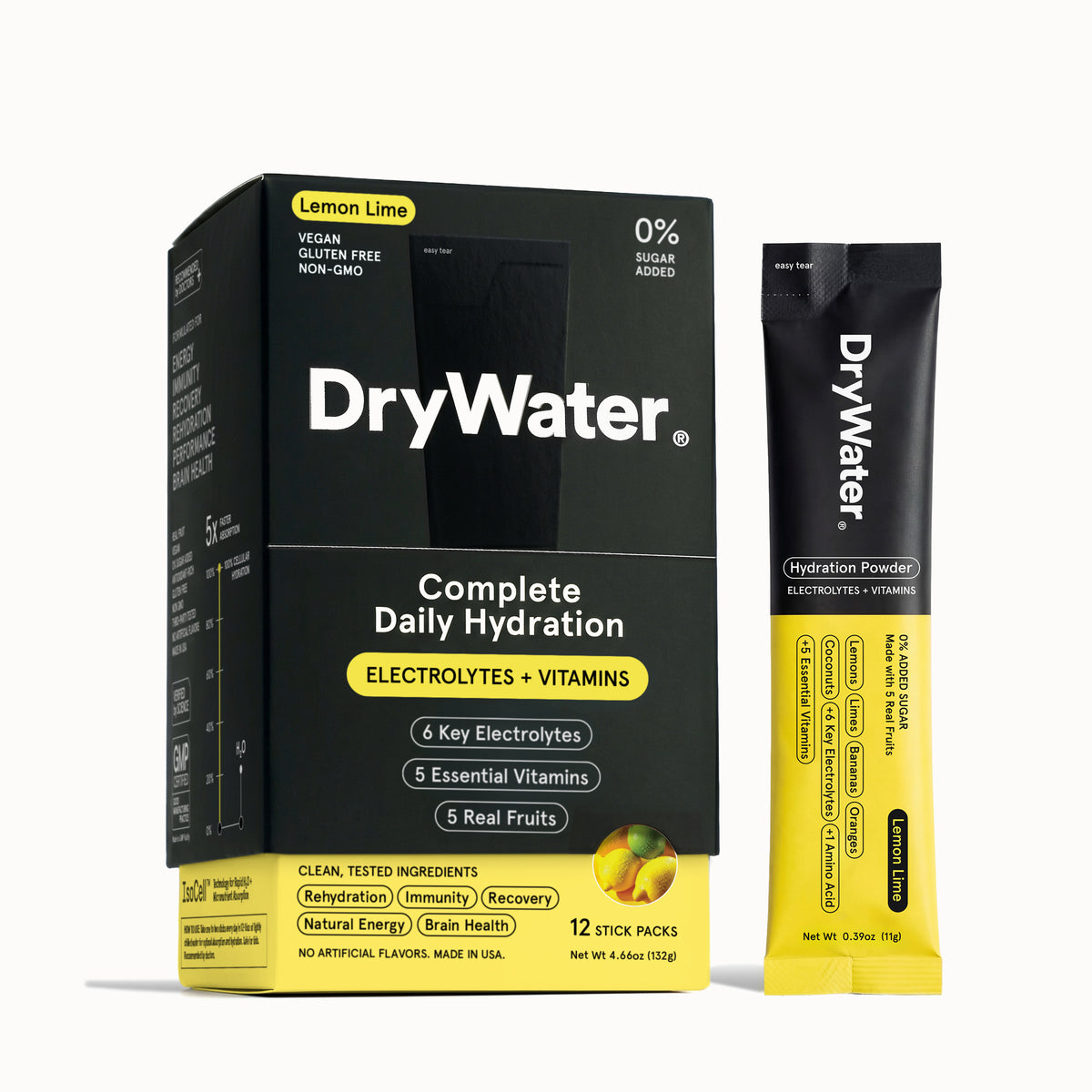
DryWater ingredients and nutrition facts
According to the DryWater Complete Hydration Powder product page, each 11 g stick contains:
1,000 mg potassium, 380 mg sodium, 150 mg chloride, around 40 to 45 mg magnesium, around 40 mg calcium, and zinc.
It also includes vitamin C and several B vitamins (B3, B5, B6, and B12), plus glycine, an amino acid.
It’s around 10 to 15 calories a stick, with 0 g added sugar and under 1 g of total sugar, which comes from the real dried fruit in the mix.
The base is built from ingredients like potassium citrate, sodium citrate, pink sea salt, magnesium citrate, coconut water powder, and real dehydrated fruit such as lemon, raspberry, peach, and blueberry depending on the flavor.
What DryWater is sweetened with
This was the part I checked most carefully, so I want to be clear about it.
Most DryWater flavors are sweetened with a small amount of water-extracted stevia leaf and monk fruit (luo han guo). Both are plant-based. Neither is an artificial sweetener in the way sucralose, aspartame, or acesulfame K are.
If you’d rather skip stevia, DryWater now makes two stevia-free flavors: Raspberry Lemon and Green Apple. Those are sweetened with monk fruit and katamfe fruit extract instead, which are also plant-based.
So whichever flavor you pick, there’s no sugar and no artificial sweeteners. It’s not “unsweetened,” though. If you avoid every kind of sweetener, natural ones included, DryWater isn’t for you.
Why the potassium matters
The thing I like most about the formula is the balance.
A lot of electrolyte drinks lean hard on sodium. That makes sense for endurance athletes losing a lot of salt in sweat. But most people eating a modern diet already get plenty of sodium. What they’re short on is potassium.
DryWater has more than twice as much potassium as sodium. For someone like me, who’s skipping a meal rather than running a marathon, that’s the right way round. I’m replacing what I’d normally get from food, not what I’d lose in a two-hour workout.
How I use it
One stick in about 12 to 16 oz of water, which is what DryWater recommends. I have one in the morning while I’m working and before my first meal. On hot days, or days I train, I’ll have a second one in the afternoon.
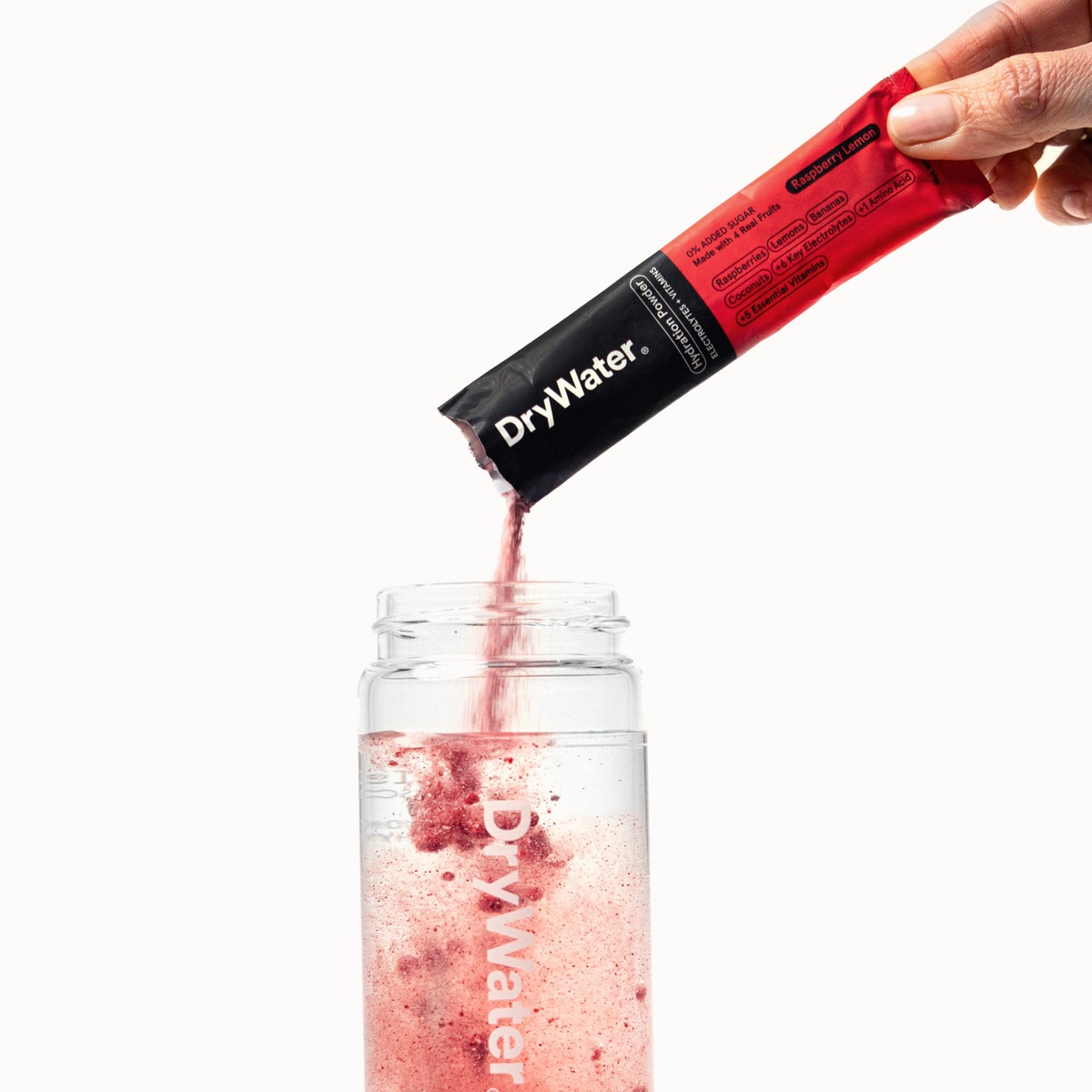
That’s it. It’s not a replacement for drinking plain water. It’s what makes the water work better and makes it easier to drink more of it, because it actually tastes good.
Lemon Lime is my default.
DryWater flavors
DryWater comes in five flavors. Each one gets its taste from real fruit powders, not artificial flavors.
Lemon Lime: lemon, lime, and orange fruit powders, with coconut water and banana. This is the one I drink most.
Mixed Berry: strawberry, cranberry, and blueberry, with coconut water and banana.
Peach Mango: peach and orange powders with natural peach, mango, and vanilla flavor.
Raspberry Lemon (stevia free): raspberry and lemon fruit powders with beet root juice, sweetened with monk fruit and katamfe.
Green Apple (stevia free): the newest flavor, made with apple fruit powder, apple cider vinegar, and a little cinnamon, also sweetened with monk fruit and katamfe.
There’s also a Variety Pack of 24 sticks if you want to try a few before you settle on a favorite.
Third-party testing
DryWater says it’s NSF Certified for Sport, gluten-free certified, vegan, and non-GMO, and that every batch goes through analytical and microbiological testing.
I like that. NSF Certified for Sport is the certification athletes look for when they need to know a product contains what the label says and nothing it shouldn’t. For something I drink every day, that’s the level of trust I want.
Here’s a short video from DryWater on how they think about making it:
DryWater vs Liquid I.V. and LMNT
If you’re researching DryWater reviews, you’ve probably also looked at Liquid I.V. and LMNT. They’re the two biggest names, so it’s worth showing where DryWater fits.
DryWater vs Liquid I.V.: The original Liquid I.V. Hydration Multiplier has around 11 g of sugar per stick. That sugar is there on purpose, because glucose helps your body absorb sodium and water faster. It’s a good choice if you’re doing long exercise and burning through your glycogen. But for someone skipping breakfast and avoiding sugar, it defeats the purpose. DryWater has 0 g of added sugar.
DryWater vs LMNT: LMNT has 1,000 mg of sodium and 200 mg of potassium per stick, with no sugar. It’s built for heavy sweaters, endurance training, and people on low-carb diets. DryWater flips the ratio, with 1,000 mg potassium and 380 mg sodium. For everyday hydration at a desk, that’s closer to what I want. LMNT Info.
So here’s how I’d sum it up. Liquid I.V. is for fast absorption with sugar. LMNT is for high salt. DryWater is for clean, balanced, everyday hydration.
DryWater price: is it worth it?
DryWater costs $24 for a box of 12 sticks, which is $2 a stick. Bigger boxes bring that down: $44.40 for 24 sticks (about $1.85 each) and $86.40 for 48 sticks (about $1.80 each). There’s also a Subscribe and Save option that takes 20% off.
Prices are in US dollars, as listed on the DryWater site in October 2026.
That’s not cheap compared with tap water. But it’s not fair to compare it with tap water.
The fair comparison is with what I’d otherwise grab. A bottled iced tea or soft drink here costs about the same, and comes with sugar, sweeteners, or both. A coffee shop drink costs more.
For roughly the price of a soda, I get a drink with no sugar, no artificial sweeteners, real electrolytes, and vitamins. That’s an easy trade for me.
Where does DryWater ship?
Orders ship within one business day. In the US, shipping is $6.95 by USPS Express and takes 2 to 3 days. DryWater is also sold in Walgreens stores.
It ships internationally too. To Portugal, the UK, Canada, Australia, and Germany, shipping is $24.95 by UPS Worldwide Expedited, and it takes 5 to 7 days.
Living in Portugal, that $24.95 is the part I plan around. Ordering a 48-stick box once makes a lot more sense than ordering a 12-stick box four times.
How to build a simple hydration habit
You don’t need a complicated system. This is what works for me.
Start the day with a big glass of water before coffee. Your body has gone all night without fluid, and this is the easiest win of the day.
Keep a drink within reach while you work. If it’s in front of you, you’ll sip without thinking. If it’s in the kitchen, you won’t.
Use electrolytes if you skip breakfast or fast. Plain water on an empty stomach isn’t enough on its own. One stick of DryWater in the morning covers that gap for me.
Drink before you snack. If you’re hungry outside your normal mealtimes, have a glass of water and wait 15 minutes.
Pair it with movement. Every time you get up to refill your glass, stretch for a minute. You’re building two habits for the effort of one.
Check the color. Pale yellow urine is the simplest sign you’re doing fine. Dark yellow means you’re behind.
And if you’re older, or looking after someone who is, don’t rely on thirst. It becomes a less reliable signal with age. Drink on a schedule rather than waiting to feel it.
The bottom line
I didn’t become a naturopath in the end. But the most useful thing I took from that course still holds up today. Get the basics right first.
Hydration is the basic most people get wrong, quietly, every day. The research suggests it affects your mood, your focus, your appetite, and possibly how fast you age. It costs almost nothing to fix.
For me, the fix is plain water through the day, stretching, and one clean electrolyte drink in the morning while I’m skipping breakfast.
That drink is DryWater. It has no sugar, no artificial sweeteners, real potassium and sodium, and it’s third-party tested. In a country where even regular iced tea can come with edulcorantes, that matters to me.
If you want to try it, start with a box of 12 and drink one a day for two weeks. Pay attention to your afternoon energy and how often you reach for a snack. That’s the simplest way to find out if it works for you.
DryWater FAQ
Is DryWater sugar free?
DryWater has 0 g of added sugar and less than 1 g of total sugar per stick. The small amount of natural sugar comes from the real dried fruit in the formula.
Does DryWater have artificial sweeteners?
No. Most flavors are sweetened with stevia leaf extract and monk fruit. The stevia-free flavors, Raspberry Lemon and Green Apple, use monk fruit and katamfe fruit extract. All of these are plant-based. DryWater contains no sucralose, aspartame, acesulfame K, or other artificial sweeteners.
What flavors does DryWater come in?
DryWater comes in Lemon Lime, Mixed Berry, Peach Mango, Raspberry Lemon, and Green Apple, plus a Variety Pack. Raspberry Lemon and Green Apple are stevia free.
Is there a stevia-free DryWater?
Yes. Raspberry Lemon and Green Apple are stevia free and are sweetened with monk fruit and katamfe fruit extract instead.
Can I drink DryWater while fasting?
At around 10 to 15 calories per stick, DryWater is very low in calories. Whether that counts as breaking a fast depends on how strict your fasting is. I drink it in the morning while skipping breakfast, and for my purposes, the electrolytes are worth it.
How many DryWater sticks can you have a day?
DryWater says multiple servings a day are fine. I usually have one, and two on hot or active days. If you’re watching your potassium for a medical reason, check with your doctor first.
Where can I buy DryWater?
You can buy it directly from the DryWater website, which is also where you’ll find the subscription discount and the full range of flavors. In the US, it’s also sold at Walgreens.
Does DryWater ship internationally?
Yes. DryWater ships to countries including Portugal, the UK, Canada, Australia, and Germany by UPS Worldwide Expedited, which costs $24.95 and takes 5 to 7 days. US shipping is $6.95 and takes 2 to 3 days.

Hey, I’m Andrew. I moved to Portugal from Nova Scotia, Canada. Follow my journey here.
I’ve been building and monetizing content sites since 2003. I have built and ranked dozens of sites over many years, and I built my own WordPress SEO plugin, called SEOMedic. Now I build niche directory sites and teach others to do the same.
I’m certified in Claude and Claude Code, and a certified Systeme.io funnel builder. I run Reddit and YouTube ads for clients.
Read more of my articles on Medium.
Book a free Zoom call if you want a fresh set of eyes on your business.
