
Last updated:
Last updated November 11, 2026. Some links in this post are affiliate links. If you buy through them, I may earn a commission at no extra cost to you.
Here’s the quick summary on Filmora. For general use, Filmora is excellent.
The UI (user interface) is straightforward and pretty easy to learn. Plans start at $49.99 a year, or $79.99 once for a perpetual licence. The current version is Filmora 16, and it’s leaned hard into AI since I first reviewed it.

It’s fast, easy to learn, and offers enough advanced features to keep you content for years. There are loads of motion graphics, lower thirds, and neat little tricks to make your videos stand out and give the impression you’re a pro at video editing.
The truth is, having those little flairs, like lower thirds that move dynamically, shows professionalism and polish. That keeps people watching and makes your video better.
Filmora is simple to use and lets you get creative without getting bogged down with technical hurdles.
Filmora Pricing in 2026
Pricing has changed a lot since this review first went up. Here’s what Wondershare’s own pricing page shows for individuals as of November 2026, in US dollars:
| Plan | Price | What you get |
|---|---|---|
| Free | $0 | Basic editing features, but exports carry a Filmora watermark |
| Basic | $49.99/year (listed at $59.99) | No watermark, 4K export, version upgrades, 1 GB cloud storage, works on Windows and Mac |
| Advanced | $59.99/year (listed at $69.99) | Everything in Basic, plus 1,000 AI credits a month and 10 GB cloud storage |
| Perpetual | $79.99 one time (listed at $129.99) | No watermark, 1,000 AI credits once, updates within Filmora 16 only, one operating system |
Prices shift with Wondershare’s promos, so check the current Filmora pricing before you buy. There’s a 30-day money-back guarantee.
So which one? If you mostly cut, trim and add titles, Basic is enough. If you plan to lean on the AI tools, get Advanced, because most of those burn credits. The perpetual licence looks cheapest over time, but keep in mind it stops at Filmora 16. When Filmora 17 comes out, you’d pay again to upgrade.
What’s New in Filmora 16
Filmora 16 landed in September 2026. The headline additions are Camera Tracking, Color Mask, 360° Video Reframing, AI Media Analysis, Smart Text Correction and Multi-Source Recording.
The bigger change over the last year is AI. Filmora now has text-to-video and image-to-video (using Google’s Veo 3.1), AI Extend to lengthen a clip, AI Relight, Topaz-powered video upscaling, an AI Video Object Remover, AI Eye Contact, and an AI assistant called AI Mate.
Here’s the catch. Most of those AI features run on AI credits. That includes text-to-speech, speech-to-text, AI music, AI translation and the object remover. A few are free on every plan: Smart Search, Auto Reframe, AI Face Mosaic, AI Portrait and AI Color Palette.
Pros
- Very polished interface.
- Inexpensive compared to Adobe Premiere Pro.
- Loads of cool visual effects and overlays (check out the selection below).
- Subscriptions now cover both Windows and Mac on one licence.

Cons
The branding has always been a little confusing. Filmora 10 and Filmora X were the same product, and the plan names and AI credit rules today take some reading to figure out.
I did find that Filmora 9 crashed periodically. That was sorted out in later versions.
4K exporting is a little bit slow, but you can customize the output to fine-tune your final product.
And the AI features cost extra in practice. Basic doesn’t include monthly AI credits, so if you want the AI tools, budget for Advanced.
So Is Filmora Any Good?
Many video editing programs claim to offer professional results, but the interface is difficult to understand and the results are not ideal.
I have used Camtasia, Screenflow, Snagit, iMovie, Sony Vegas, and Filmora. I have also tried and nearly immediately deleted Shotcut, Lightworks, DaVinci Resolve, Blender, Openshot, HitFilm, and a few others. The main problem with the free video editors is that they suck! They have really old-looking UIs and they are just not easy to figure out and get started using.
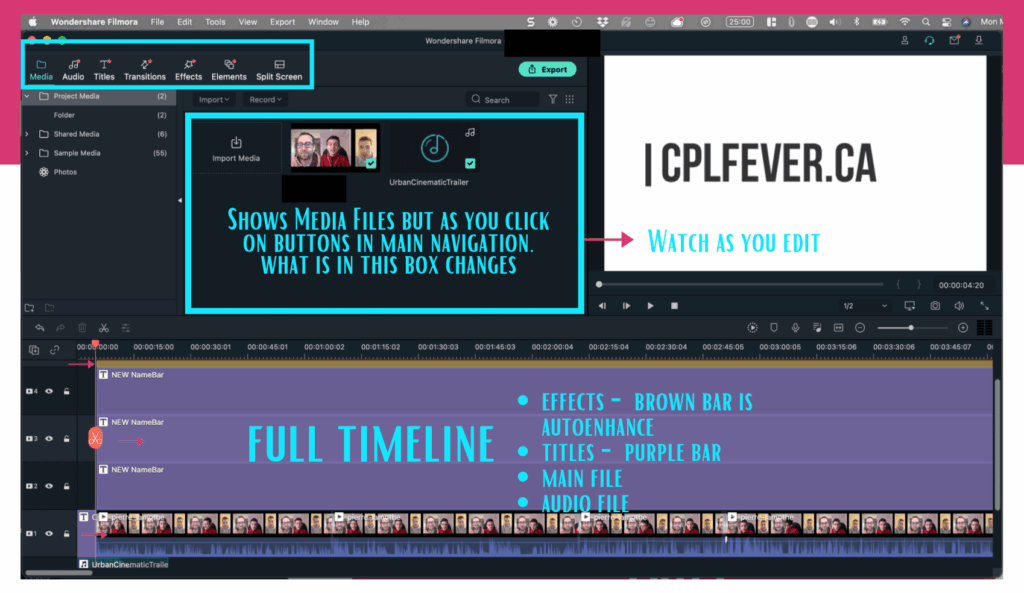
Filmora is a gem in that somebody with very little editing experience can jump in and produce something nice-looking in a matter of minutes. Take a look at the interface below. It’s very intuitive. And it’s fun to work with!

Of all the video editors, Filmora has the fun factor locked in. It’s made for the YouTube-TikTok-IG age. There are silly and fun overlays that I think other video editors would think were beneath them. (Looking at you, Adobe Premiere!)
One of the standout features is split screen. You can drag different clips into pre-divided frames and get an instant split-screen effect like the one used in the documentary on Woodstock. Filmora 15.7 added Split Screen Templates to make that even quicker.
Filmora is one of a few consumer-level tools that actually delivers a great editing experience and a simple workflow.
Wondershare
Filmora was originally released as Wondershare Video Editor, but after version 5.1.1 it was rebranded as Filmora. Wondershare also makes other tech products like Dr.Fone, which helps manage and recover iPhone data.
Can I Use Filmora on Mac and PC?
Yes, and this has gotten better. The Basic and Advanced subscriptions work on both Windows and Mac under one licence, and your AI credits are shared across both. The perpetual licence is tied to one operating system, so you’d need a separate one for each.
There are also Filmora apps for iPhone, iPad and Android, but the desktop licences don’t carry over to mobile.
On Windows, Wondershare lists 8 GB of RAM as the minimum. For HD and 4K editing they recommend an Intel 9th Gen or newer CPU, 16 GB of RAM and 4 GB of VRAM.
It’s made for non-professional video editors. Great for anyone who wants to add polish and sizzle to their YouTube videos. That’s not to say you can’t use it for more elaborate projects, but I wouldn’t suggest using it for a full-length documentary.
Multiple Tracks
With Filmora you can add multiple tracks. There is not a limit on how many tracks, so you can easily add elements and sound to spice up your videos.
One nice thing about the tracks is Filmora keeps them separated with the video tracks in the middle, the audio tracks at the bottom, and the overlay tracks on the top. This really makes it easy to organize your project if you have multiple tracks.
Motion Tracking and Face Effects
Motion tracking arrived back in Filmora X, and it’s still one of the fun ones. You can have a cartoon head follow a face or easily blur it out with an effect called Face-Off. Filmora 16 takes this further with Camera Tracking.
This can be useful for creating those catchy GIF memes.

Audio Ducking
Ducking drops the background music slightly when a person is talking in a clip, so they’re not competing with it. Professionals would probably balk at doing it automatically. For most Filmora users, it improves the video without any extra time.
There are a ton of filters to give your clips a little extra oomph. Some of these are quite dramatic, so think of them as Instagram filters for your video clips. I think this is where Filmora really shines for amateur filmmakers and YouTubers.
The key to success online is grabbing and holding attention. And the filters and overlays are what really set Filmora apart for me. Just a little bit of work and you can make any video stand out. Try it for yourself and you’ll see what I mean.
Colour Correction
There’s a large number of preset colour filters. Each clip has a Color tab where you can adjust sliders like contrast, brightness and colour temperature, or let Filmora adjust colour and white balance automatically.
Color matching is the handy one. You select a clip in your timeline, then pick another clip to match it with, so both end up with a similar colour palette. It’s very helpful if you filmed under different light sources. Filmora 16 also adds Color Mask, so you can adjust one colour in a shot without touching the rest.
Where Filmora Falls Short for Me
In my personal experience, I prefer using Descript. The reason is simple: I can edit my video by editing the transcript. Delete a sentence in the text and it’s gone from the video. I wrote more about how that cuts my editing time.
I also find that the default export folder is a little buried on the Mac. It’s in your home folder, under Movies, then Wondershare Filmora Mac, then Output. There are a lot of folders in there, so it’s not ideal.
If I’m doing a ton of edits, I don’t want to keep digging through all that to find my files.
Projects can also break if you move the source files. That can be a real problem. Keep it in mind if you’re going to re-edit something after a long gap, or if you clear space off your computer and move files around.
Filmora FAQ
As of November 2026, Wondershare lists Basic at $49.99 a year, Advanced at $59.99 a year and a Perpetual licence at $79.99 one time, all in US dollars. Those are promo prices, so check the pricing page before you buy.
There’s a free version with the basic editing features, but every export carries a Filmora watermark. To remove it, you need a paid plan.
No. The perpetual licence includes updates within Filmora 16 only. When the next major version comes out, you’d pay again to upgrade. The Basic and Advanced subscriptions include version upgrades.
Yes, with a subscription. Basic and Advanced work on both Windows and Mac under one licence, and AI credits are shared across both. The perpetual licence only works on one operating system.
By default, Filmora saves exports in your home folder, under Movies, then Wondershare Filmora Mac, then Output. It’s a little buried, so it’s worth knowing before you go looking for a finished video.
For my own videos, I prefer Descript, because I can edit the video by editing its transcript. Filmora is the better pick if you want lots of effects, overlays and templates in an editor that’s easy to learn.
Final Thoughts
Wondershare Filmora balances useful features with an intuitive interface at an affordable price. It handles HD and 4K editing and export, and it now has a deep set of AI tools if you’re willing to pay for credits.
It’s not a professional video editing suite, but most beginners and intermediates will be happy with the results. Start with the free version to see if the interface clicks for you, then pick Basic or Advanced depending on how much AI you’ll use.
Download Filmora for Mac or Windows today.

Hey, I’m Andrew. I moved to Portugal from Nova Scotia, Canada. Follow my journey here.
I’ve been building and monetizing content sites since 2003. I have built and ranked dozens of sites over many years, and I built my own WordPress SEO plugin, called SEOMedic. Now I build niche directory sites and teach others to do the same.
I’m certified in Claude and Claude Code, and a certified Systeme.io funnel builder. I run Reddit and YouTube ads for clients.
Read more of my articles on Medium.
Book a free Zoom call if you want a fresh set of eyes on your business.
